When Professor Matthew Schrag of Vanderbilt University picked up a phone call a year ago, he would not have imagined that he would cause an uproar in the scientific community, much less that he might shake the Alzheimer's disease field for more than a decade. foundation. But it happened so dramatically. One paper, 16 years, nearly 2,300 citations, the hopes of tens of millions of patients, and nearly $300 million in research funding may all be built on shaky foundations. An in-depth investigation report published today in the journal Science suggests that the research and development of this major disease may have been led astray.
▲ "Science" magazine called Professor Matthew Schrag the "whistleblower" of this event (Image source: Vanderbilt University official website) Professor Schrag, a young Alzheimer's scientist, has previously received some attention for his public criticism of an approved Alzheimer's drug. On the phone, one of his colleagues asked him if he was interested in a job — also offered by two neurologists who wanted to short a pharmaceutical company and suspected an Alzheimer's disease Research data on treatments can be problematic. To confirm these findings, they offered $18,000 in honorarium. Finding Professor Schrag is no coincidence. His own research data also conflicted with the therapy's claimed effects, leading to concerns that volunteers participating in clinical trials would only be taking risks, not potentially benefiting from the therapy. Using his expertise accumulated over the years, Professor Schrag began to investigate the publicly available information about the therapy, as well as the scientific basis behind it, and he was surprised to find that images in several papers had been altered or reused. The most notable of these is a groundbreaking paper published in the journal Nature in 2006. In the paper, the researchers claim to have discovered a beta-amyloid isoform that they believe causes dementia in rats. Since its publication, it has become one of the most-cited Alzheimer's papers of the century and has exploded the industry, leading countless research groups to join it. Behind the research and development enthusiasm of scientists is the heart of exploring the pathology of Alzheimer's disease. In 1906, German pathologist Alois Alzheimer observed plaques and other protein deposits in the brain after dissecting the brain of a dementia patient. In 1984, scientists discovered that the main component of these plaques is beta-amyloid. In 1991, some mutated genes in familial Alzheimer's disease were identified and found to encode the precursor of beta amyloid. Pieced together, these scattered pieces of evidence suggest that beta-amyloid deposits may trigger a cascade of responses that impair neuronal function, leading to the dementia symptoms of Alzheimer's disease. Therefore, preventing the deposition of β-amyloid became the most reasonable treatment strategy at that time.
Image source: 123RF The investigation report of "Science" magazine pointed out that hundreds of clinical trials targeting beta amyloid have been launched. On the other hand, scientists studying other pathologies of Alzheimer's disease, such as immune dysregulation or neuroinflammation, complain about insufficient research funding. In 2006, all the controversy seemed to have settled. The aforementioned Nature paper dispels a swath of doubts about the beta-amyloid hypothesis, 100 years after the discovery of Alzheimer's disease. This paper comes from the research group of well-known neuroscientist Professor Karen Ashe. She studied under the tutelage of Professor Stanley Prusiner, a Nobel Prize winner, to study how prions lead to diseases of the nervous system. In the mid-1990s, she created a mouse model that produced human beta-amyloid and observed plaques in the animals' brains and dementia in the animals themselves. In the field of Alzheimer's disease, this is one of the commonly used models. By the early 2000s, scientists again began to notice the presence of "toxic oligomers," a subtype of beta amyloid that dissolves in body fluids and may be more harmful than insoluble protein deposits. Studies have linked these oligomers to abnormal communication between neurons, and human studies have found higher levels of these oligomers in Alzheimer's patients. But no one could definitively show that such oligomers directly lead to cognitive decline.
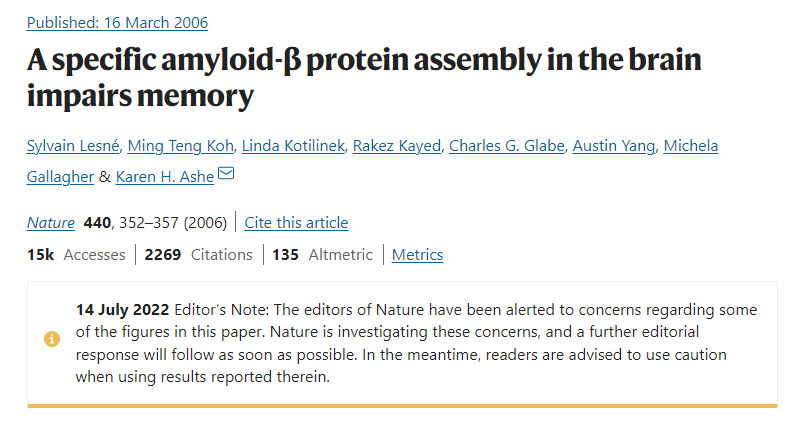
▲This paper has been marked as "under investigation" (Image source: Screenshot of the official website of "Nature") Please click the source link above for full story originally in Chinese. |
| |||||||||||||||||||||||||||


So click the pen to speak out.